

Statement of comprehensive income
A statement of comprehensive income (also known as a profit and loss account) is used to show the profit or loss the business makes over a period (usually a year).
Here is an example – click on the different elements to learn more about them:
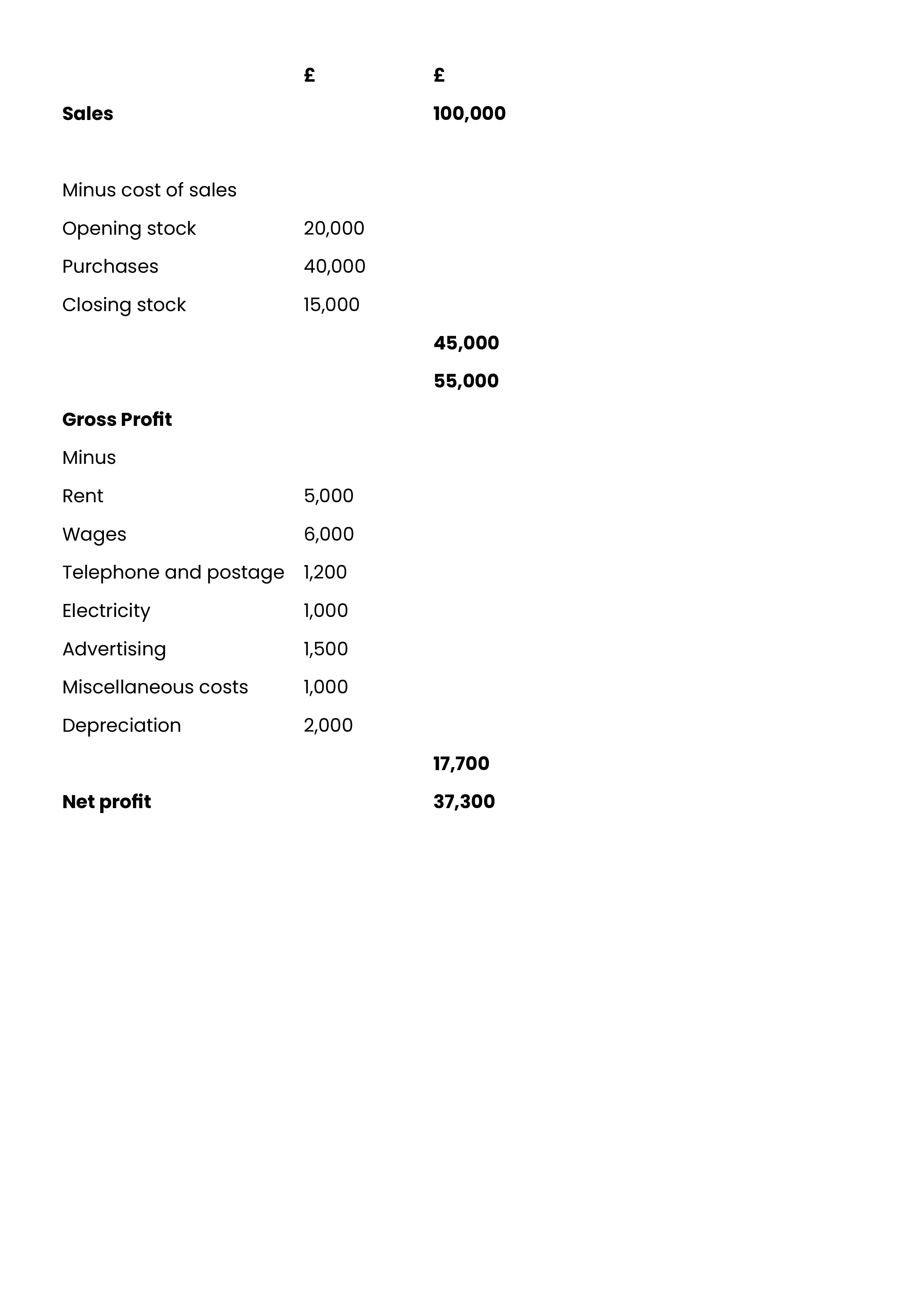
Sales
This is the income that comes into the business from the sale of goods or services.
Cost of sales
The direct costs of the sale e.g. the cost of the raw materials or the cost of providing the service.
The cost of sales is calculated as follows:
Opening stock + cost of stock purchased – closing stock
£20,000 + £40,000 – £15,000 = £45,000
Gross profit
Gross profit can be calculated by subtracting the cost of sales from the income.
Income/turnover – cost of sales = Gross profit
£100,000 – £45,000 = £55,000
The overheads will then need to be subtracted from the gross profit to calculate a net profit figure.
Net profit
The net profit is the profit after the overheads have been paid. Overheads are all indirect costs such as mail or marketing. These costs do not arise directly from the production or sale of the product or service.
Gross profit – overheads = Net profit
£55,000 – £17,700 = £37,300
Note that tax has not yet been accounted for. Tax is deducted from the net profit figure.
Watch the video for more information.