
The Marketing Campaign
So, it’s time to start thinking about designing the marketing campaign. You have done your SWOT and PESTLE analysis and examined your competitors. So now we need to consider the following:
The content of the marketing message
The message content is crucial. You need to make sure it is appropriate for your target market.
The AIDA concept is often mentioned in the context of a marketing message.
AIDA stands for:
- A(wareness) – Ymwybyddiaeth
- I(nterest) – Diddordeb
- D(esire) – Chwant
- A(ction) – Gweithred

Your marketing message should capture the attention of your market and stimulate interest to know more, then it should excite your target market so that they buy your product or service.
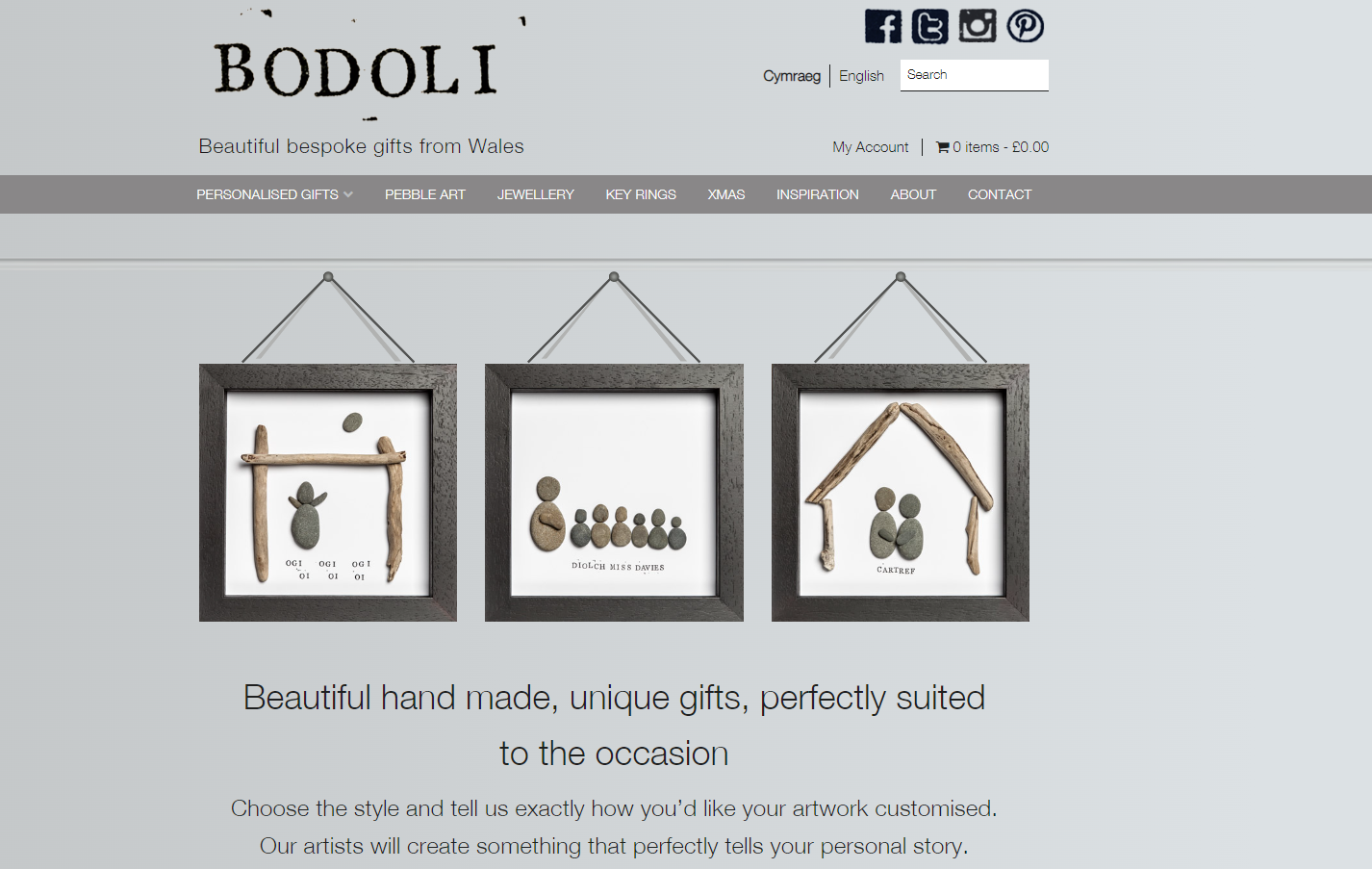
Take a look at the screenshot from the ‘Bodoli’ website to see the AIDA principles in action.
At the top of the page it raises awareness of the offer: ‘Beautiful bespoke gifts from Wales.’
It builds interest by showing pictures of the goods and then builds desire by describing the goods using words like ‘unique’ and ‘perfect’.
Finally, there is a dedicated ‘call to action’ button for the customer to easily order the product.
Choosing an appropriate marketing mix
In a marketing campaign the 4Ps must be combined. For example, if you’re marketing a luxury product the promotional activities – as well as the sales locations and price – will need to reflect that aspect or your message will be confusing and the customer will not understand it.
Also, every element of the marketing mix should be suitable for your target market.
Choosing the appropriate media is essential in order to reach your target market within your budget. Some forms of media advertising can be very expensive to produce and display, e.g. TV ads, but it’s beneficial for big companies that can reach a wide target market. However, these are not effective in reaching niche target markets. For some niche markets specialist journals might be better.
A budget is the expenditure plan during the campaign. A budget ensures that there is no campaign overspend and helps to make decisions regarding appropriate media. Without a budget it would be very easy for costs to get out of control, so it is important to assign a financial value to each part of the campaign. For example, if you are planning billboard posters you will need to allocate funds for designing the content of the poster, creating the posters and hiring locations to display the posters.
Timelines for the campaign, including monitoring
Timelines are a good way to ensure that the whole project stays within deadlines. There are a number of websites that you can use to plan timetables, for example Monday.com, and you can also use a spreadsheet program such as Excel. You can also create a Gantt Chart.
In a Gantt Chart you break the campaign down into individual tasks. You can then designate a period of time and individual(s) for each task. By doing this you can make sure that the whole project will be completed on time. It’s also important to build monitoring activities into the Gantt Chart, e.g. monitoring meetings to ensure everything is completed as appropriate, adding contingency plans as needed.
Take a look at the following video:
Campaign evaluation methods
Once the campaign is over it needs to be evaluated. Information from the monitoring meetings will help answer questions such as:
What went well?
What were the weaknesses?
Is there anything we could do differently next time?
A thorough evaluation process will enable you to refine the marketing plans for your next campaign.