Contents
Unit 6: Business Decision Making
Module objectives
0/1
Sources for data collection
0/1
Using business models to help make decisions
0/1
Suitable formats for decision making in a business context
0/2
Software generated information for decision making in business
0/1
Module 2: Business Decision Making

Using business models to help make decisions


Businesses can use a number or combination of models to analyse their internal and external environment. Analysing the business environment provides a structure for a business to fully consider the situation. While there is never total certainty about what is going to happen in the future, careful analysis of the market can lead to better decision making.

Click on the model for further information:

The Ansoff matrix


The Ansoff Matrix suggests four different strategies for growth, which depend on the product and the market. It offers different strategies depending on whether the product is new or existing and whether the market is new or existing.


Market Product
Existing New
Existing Market penetration Product development
New Market development Diversification


Market penetration
In order to grow in a market that exists with a product that exists, Ansoff's model proposes that a business should try to penetrate the market, i.e., try to get the customer to buy more of the product or ensure that customers use their brand rather than that of another business.
Product development
With a new product in an existing market, the focus should be on developing the product, according to Ansoff. Mobile phone companies follow this strategy and launch new versions of their phones regularly.
Market development
On the other hand, if the product exists but the market is new, then the market will need to be developed, e.g. marketing the product in another country.
Diversification
This is when a business develops a new product in a new market. This is the strategy that involved the most risk in the short term but it can be worth the risk, if successful, as a business will not be dependent solely on their existing markets and products.

You can see more about the Ansoff Matrix here:

You can see more about the Ansoff Matrix here:

The Boston Matrix


The Boston Matrix is a model that focuses on analysing the products in a business’ portfolio. Businesses can then develop strategies that suit that product.

This matrix places the products in a company's portfolio in one of four categories, depending on the market share of the product and market growth.
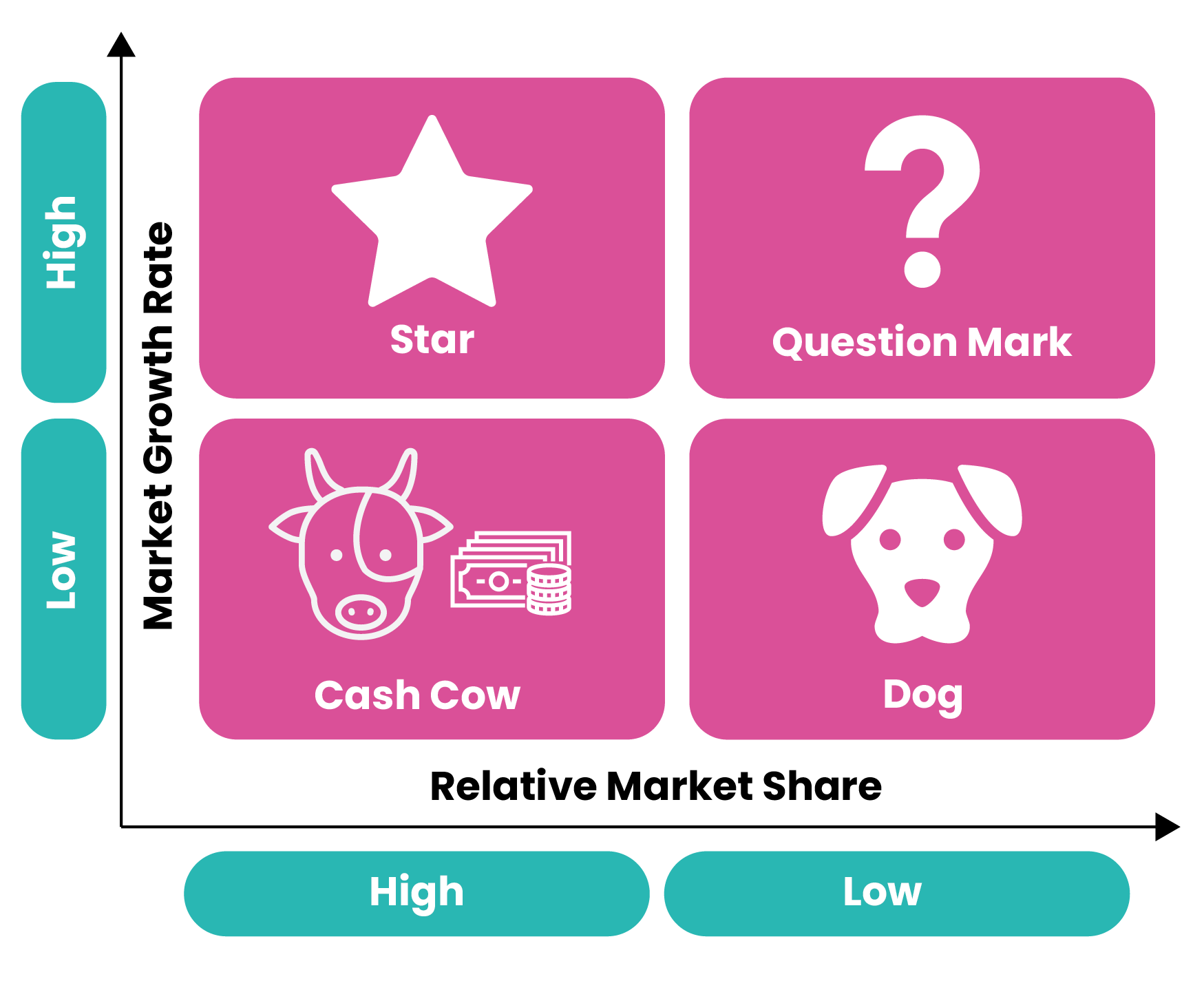

Star
This is a product with a high market share in a growing market. A star can be a very profitable product but in a growing market, so it is likely to have stiff competition. Therefore, it is necessary to advertise and promote the product in order to keep it in the minds of customers.
Cash Cow

This type of product has a high market share in a market that is growing slowly or has ceased to grow. These products are stable performers but a business needs to ensure that customers are not attracted to other businesses and products.

Question mark
These products have low market share in a growing market. As the market grows, there is potential for this product to turn into a star but it may take a lot of marketing and promotion to make this happen.
Dog
A dog is a product with low market share in a stable market. The product may be taken off the market or perhaps, since the product is not expensive to maintain, it will be kept in the company's product portfolio to continue to bring in some revenue.

You can read more about the Boston Matrix here:

In the following video, you can see the model being applied to Apple: